Billing software for cloth shops
that sells by the metre.
Kapda Stock is GST billing software made for fabric and cloth shops in India. Bill a 2.75-metre cut off a thaan, print an 80 mm thermal bill with a UPI QR, keep every customer's udhaar in one ledger with automatic WhatsApp reminders, and hand your CA a GSTR-1 built from the bills you already made — even when the internet drops.
From ₹349/month · every feature in every plan · English, हिंदी, اردو, کٲشُر
Why generic billing apps don't fit a cloth shop
Most billing software is built for a grocery counter and stretched to everything else. A fabric shop breaks it in four places.
Fabric is not sold in pieces
Generic billing apps count units. A cloth shop sells 2.75 metres off a 40-metre thaan, and the 1.2 metres left at the end is a remnant, not a lost sale.
Udhaar lives in a khata
Half the shop’s money is written in a notebook. Nobody knows the true outstanding, and reminders depend on whoever remembers.
GST is a monthly scramble
HSN codes 5001–6310, garment rates that change with the sale value, CGST/SGST versus IGST — the CA rebuilds it all from paper every month.
The internet is not reliable
A billing app that stops when the connection drops is a billing app the counter staff will stop trusting.
What a cloth shop actually uses, screen by screen
Real screenshots of the app running on demo data — not mock-ups.
Bill by the metre, print in seconds
Products carry their own unit — MTR, YARD, KG, DOZEN, SET, PCS or ROLL — so a 2.75 m cut is billed as 2.75 m. Scan a barcode or search by name, apply an item or bill discount, take cash, UPI and card on the same bill, and print an 80 mm thermal receipt with a UPI QR the customer can scan to pay.
How POS billing works →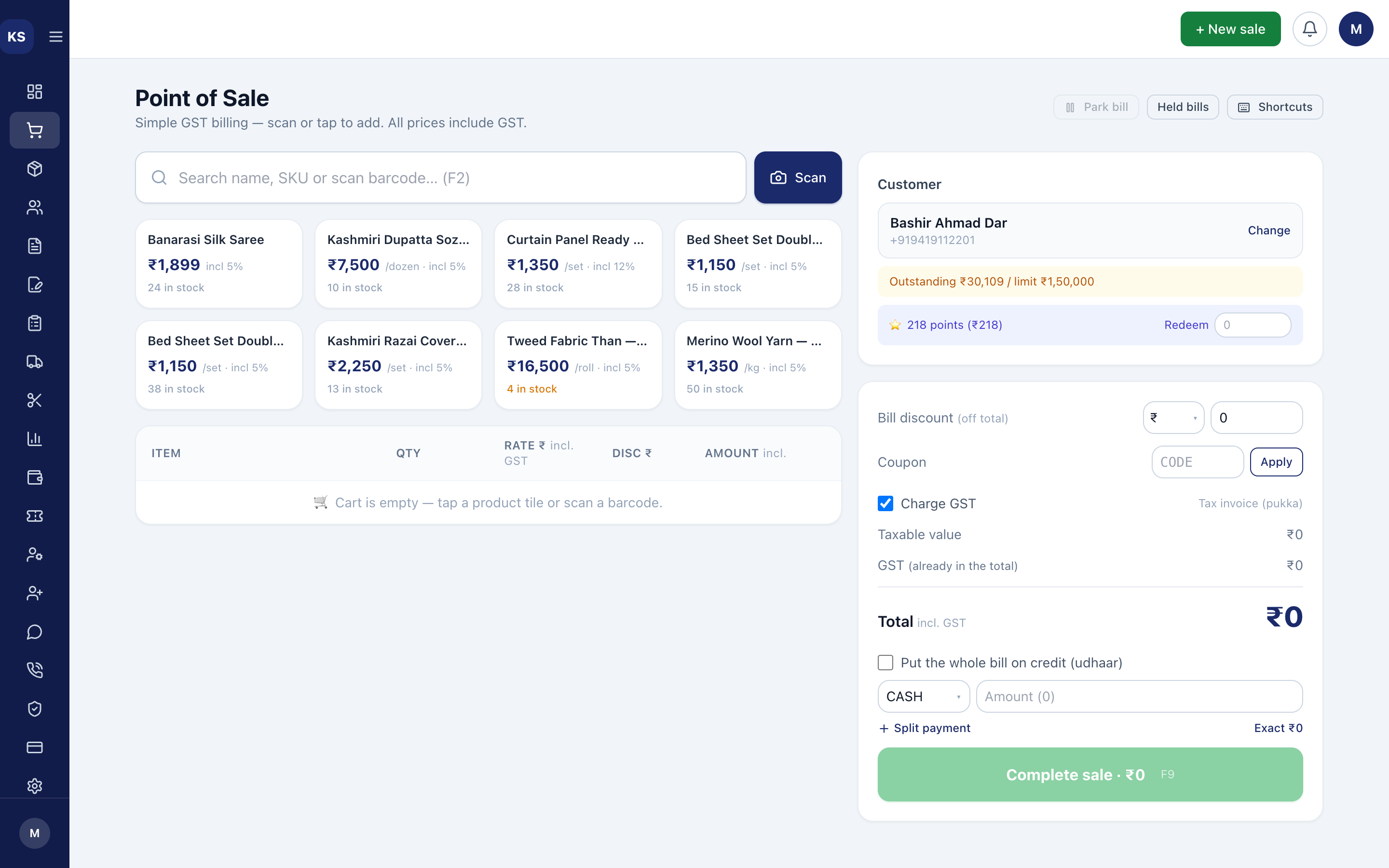
Every thaan, every colour, every size
Fabric products track rolls (thaan) and remnants (chindi) individually; garments track colour and size variants with broken-size-set alerts. Purchase batches record the date and buying price, minimum stock triggers a 9 AM low-stock alert, and HSN codes and GST rates are set once per product.
Products, units and variants →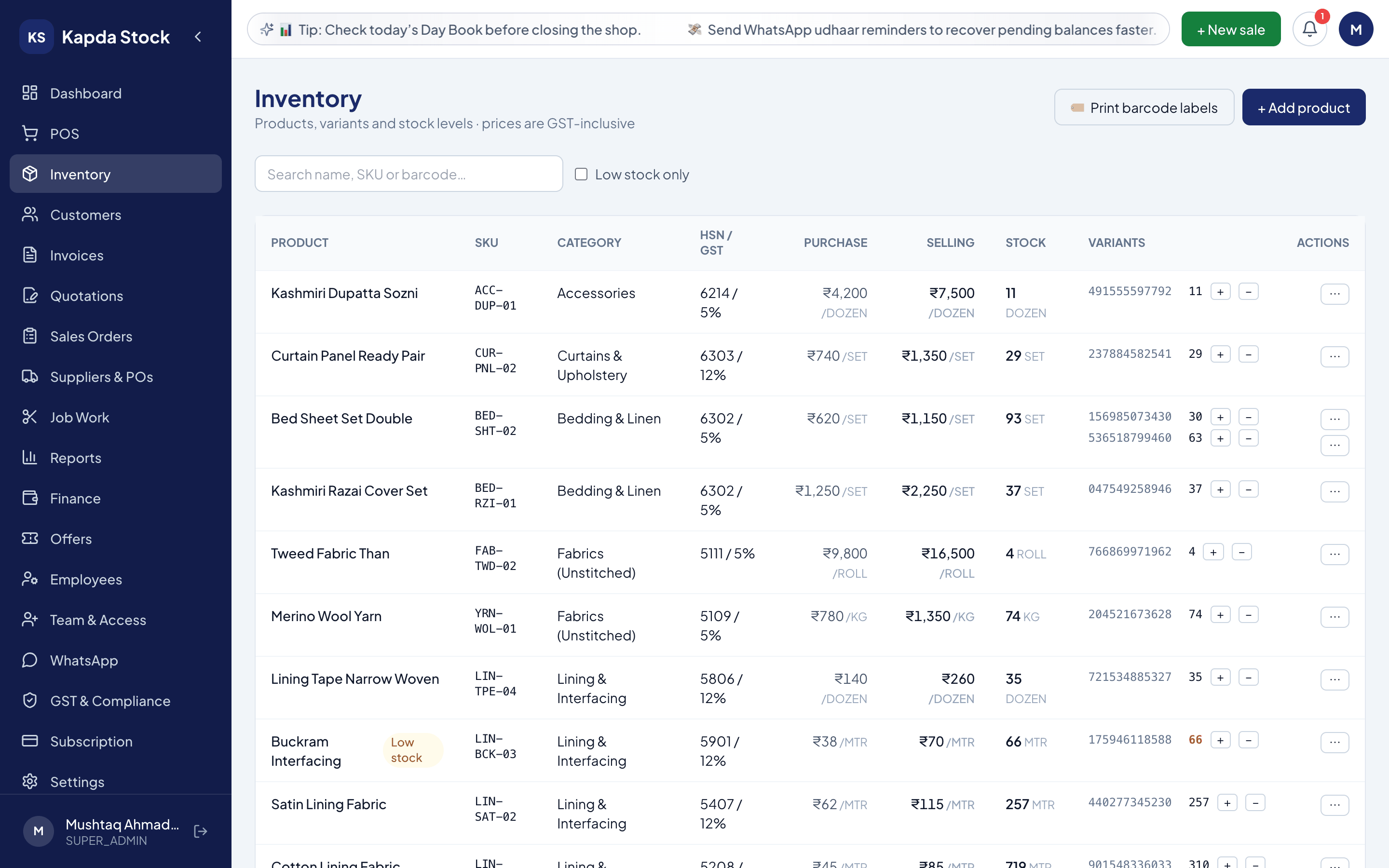
The khata book, with reminders that send themselves
Every customer has a running credit ledger with a limit. Turn on the recovery ladder and, once a day at 10:30 AM, customers with the oldest unpaid credit get a polite WhatsApp at 7 days, a reminder with a UPI payment link at 15, and an automated call at 30 — each step at most once in 30 days.
The udhaar recovery ladder →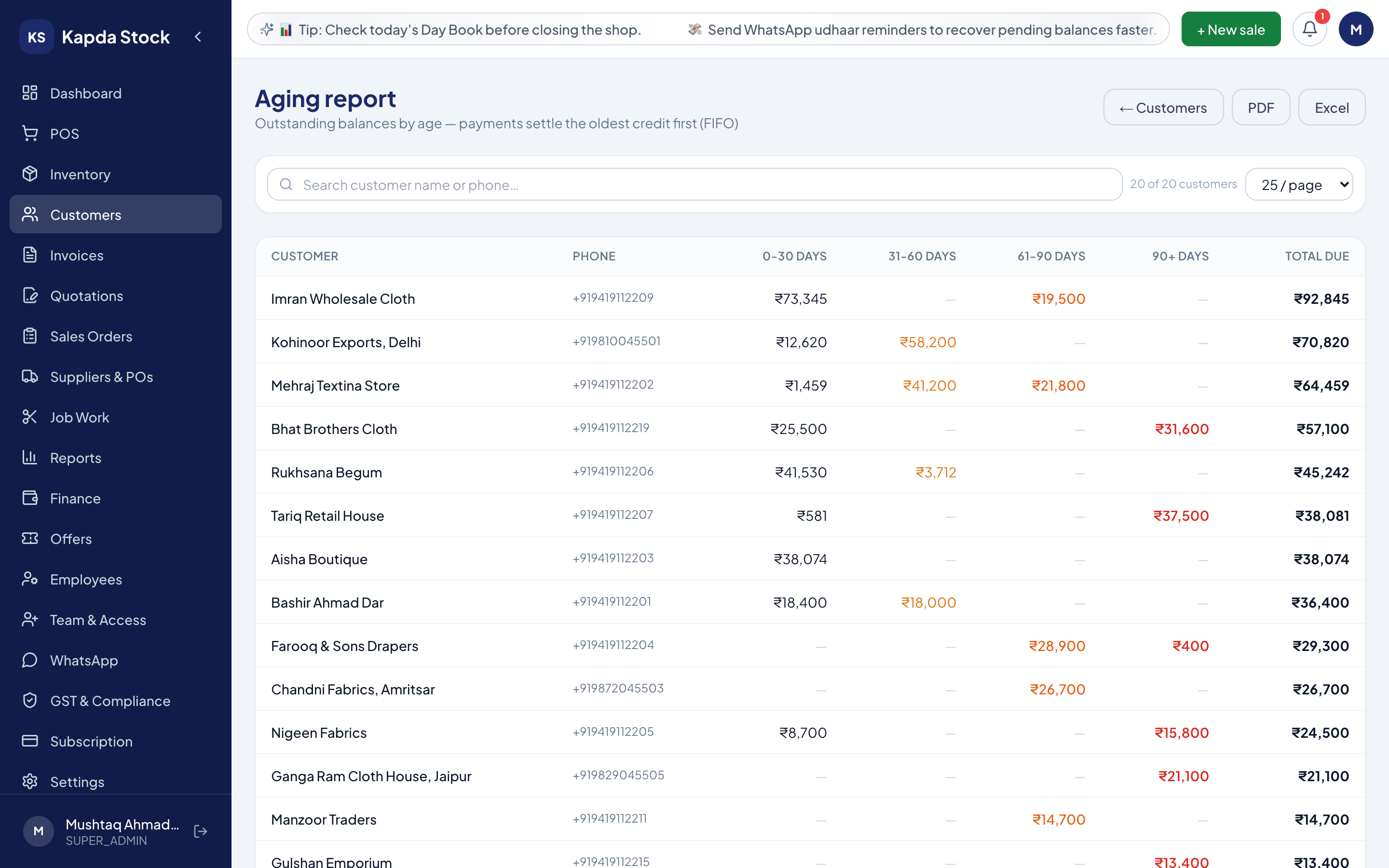
GSTR-1 from the bills you already made
CGST and SGST for local customers, IGST for another state — decided from the customer’s GSTIN. Every invoice carries HSN-wise tax, so GSTR-1 and GSTR-3B summaries come straight from your sales, with e-invoice IRN and e-way bill support when your turnover needs them.
GST returns in Kapda Stock →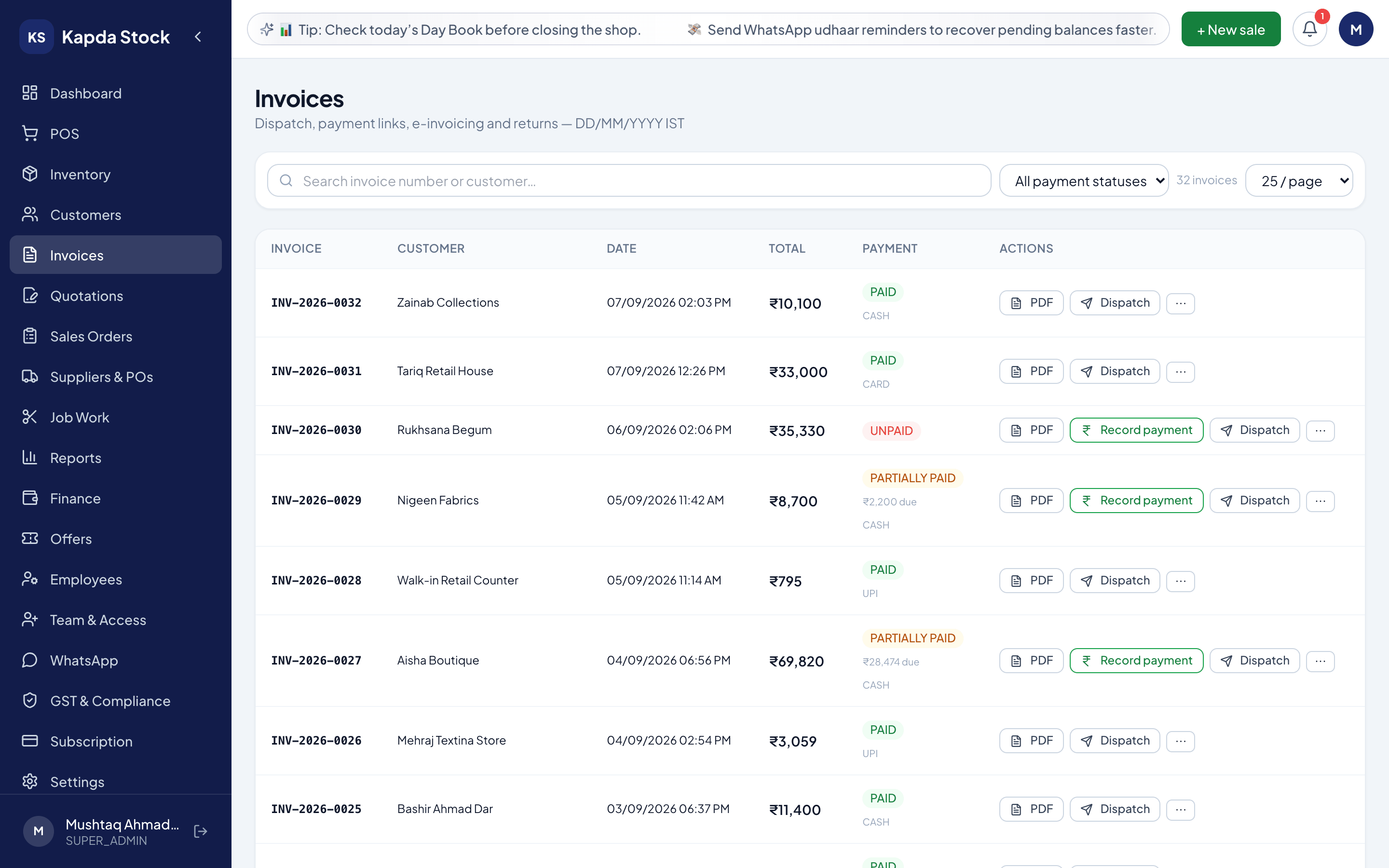
Cloth-shop billing vs. generic billing software
What to check before you buy any billing software for a fabric or garment shop.
| What a cloth shop needs | Kapda Stock | Generic billing app |
|---|---|---|
| Sell fabric by the metre, garments by the piece | ✓ | Usually pieces only |
| Roll (thaan) and remnant tracking | ✓ | ✗ |
| Colour / size variants with broken-set alerts | ✓ | Sometimes |
| Udhaar reminders on WhatsApp + UPI link + AI call | ✓ | Manual |
| Karigar job work and wages ledger | ✓ | ✗ |
| Offline billing that syncs itself | ✓ | Desktop only |
| Interface in Hindi, Urdu and Kashmiri | ✓ | English / Hindi |
| Every feature in every plan | ✓ | Tiered add-ons |
Switching from a khata book or desktop software
Most cloth shops move over in a week without closing for a day. Import your product list from Excel with bulk import, enter customer opening balances so the udhaar ledger starts correct, print one test bill on your thermal printer, then run the new app alongside the old one for a few days. The 30-day switching plan walks through it week by week.
Prefer to keep everything on your own computers? The On-Premise edition is the same product as a one-time licence that runs fully offline. The Cloud edition is the subscription — nothing to install, log in from any phone or PC.
Cloth shop billing — common questions
Yes. Each product has its own unit — MTR, YARD, KG, DOZEN, SET, PCS, BOX or ROLL — and the bill simply lists each line in its unit with GST worked out per line.
Yes. In the Cloud edition a sale that cannot reach the server is saved on the device and synced when the connection returns. The On-Premise edition runs entirely on your own computers and never needs the internet.
Any standard 80 mm ESC/POS thermal printer — the kind most Indian cloth shops already own — connects directly. A4 PDF invoices are available too, with your own template and logo.
You set the HSN code and GST rate once per product (the textile range 5001–6310 is pre-loaded). Each bill applies CGST + SGST or IGST from the customer’s GSTIN, and GSTR-1 / GSTR-3B summaries are prepared from your invoices. Your CA still files the return.
The POS is built for a queue at the counter: search or scan, tap, pay, print. Staff get their own logins with roles — cashier, salesman, manager — so nobody sees more than they need.
Growth is ₹349 a month or ₹3,499 a year and Professional is ₹599 a month or ₹5,999 a year, both excluding 18% GST. Every feature is in every plan; only the user, product and invoice limits differ. On-Premise is a one-time licence quoted by sales.
Bill your first thaan today.
Your workspace is ready in under 10 seconds. No credit card, no setup call.